'World Turtle Day', May 23

World Turtle Day is celebrated each year on 23 May to raise awareness of turtles and tortoises and the need to protect them. These remarkable reptiles have existed for more than 200 million years - even before the dinosaurs disappeared. Around the world, turtles and tortoises face threats from pollution, habitat loss and climate change.
Turtles and tortoises are symbols of patience, endurance and longevity. Some giant tortoises can live for over 100 years, making them among the longest-living animals on Earth. Their calm, gentle nature and distinctive appearance make them fascinating animals to learn about and discuss in CST sessions.
Suggested discussion points:
Have you ever seen a turtle or tortoise?
Would you like one as a pet?
Why do you think turtles are associated with wisdom and patience?
Why is protecting wildlife important?

TURTLES AND TORTOISES – WHAT’S THE DIFFERENCE?
Although they are closely related, turtles and tortoises live very different lives.
Tortoises usually live on land and have heavy, dome-shaped shells and sturdy legs for walking.
Turtles spend much of their lives in water and have flatter shells and webbed feet or flippers for swimming.
Both animals carry their protective shell with them throughout life. Their shells are actually part of their skeleton and help protect them from predators.

THE LIFE CYCLE OF A TURTLE
Most turtles begin life inside eggs buried in sand or soil. After hatching, the tiny baby turtles must make a dangerous journey to water while avoiding predators such as birds and crabs.
The life cycle includes:
Egg
Hatchling
Juvenile turtle
Adult turtle
Many sea turtles return to the very same beach where they were born in order to lay their own eggs many years later. Scientists are still amazed by this natural instinct and navigation ability.
Suggested activity:
Put the life cycle stages in the correct order
Discuss how baby animals survive in the wild
Compare turtle life cycles with birds or butterflies

DARWIN AND THE GALÁPAGOS TORTOISES
In 1835, naturalist Charles Darwin visited the famous Galápagos Islands during his voyage on HMS Beagle. There he encountered giant tortoises unlike any he had seen before.
Darwin noticed that tortoises on different islands had different shell shapes and feeding habits depending on their environment. These observations helped inspire his later ideas about evolution and natural selection.
Some Galápagos tortoises can weigh over 250 kilograms and live for more than 150 years. They became one of the world’s most famous symbols of evolution and conservation.
Discussion ideas:
Why might animals adapt differently on separate islands?
What changes have people seen in nature during their lifetime?
Why are the Galápagos Islands important?

KEEPING TORTOISES AS PETS
Tortoises have been popular pets for many years because they are quiet, gentle and fascinating to watch. However, they require specialist care and can live for decades.
Pet tortoises need:
Warmth and heat lamps
A safe outdoor or indoor enclosure
Fresh vegetables and leafy greens
Clean water
Careful handling
Some tortoises can outlive their owners, so keeping one is a long-term responsibility.
Reminiscence prompts:
Did anyone keep unusual pets growing up?
What pets were common in childhood?
Who remembers pet shops or market stalls selling tortoises years ago?

AESOP’S FABLE – THE TORTOISE AND THE HARE
One of the world’s best-known fables tells the story of a boastful hare who laughs at a slow-moving tortoise. Confident he cannot lose a race, the hare stops to rest and falls asleep. Meanwhile, the tortoise keeps going steadily and eventually wins the race. The story teaches an important lesson:“Slow and steady wins the race.”
Discussion ideas:
What does the saying mean?
Is it always good to rush?
What other sayings are there about patience and perseverance?
Linked sayings and idioms:
Slow and steady wins the race
More haste, less speed
Take your time
Easy does it

THINGS THAT MOVE SLOWLY
Some things in life seem famous for moving slowly!
Possible examples:
Snails
Sloths
Tortoises
Traffic jams
Paint drying
Glacier movement
Old milk floats
Queueing at the supermarket
Kettles boiling
Slow internet connections
Horse and cart transport
Suggested CST activities:
Name more slow-moving things
Rank them from slowest to fastest
Discuss when life seemed slower in the past
Compare modern life with earlier decades
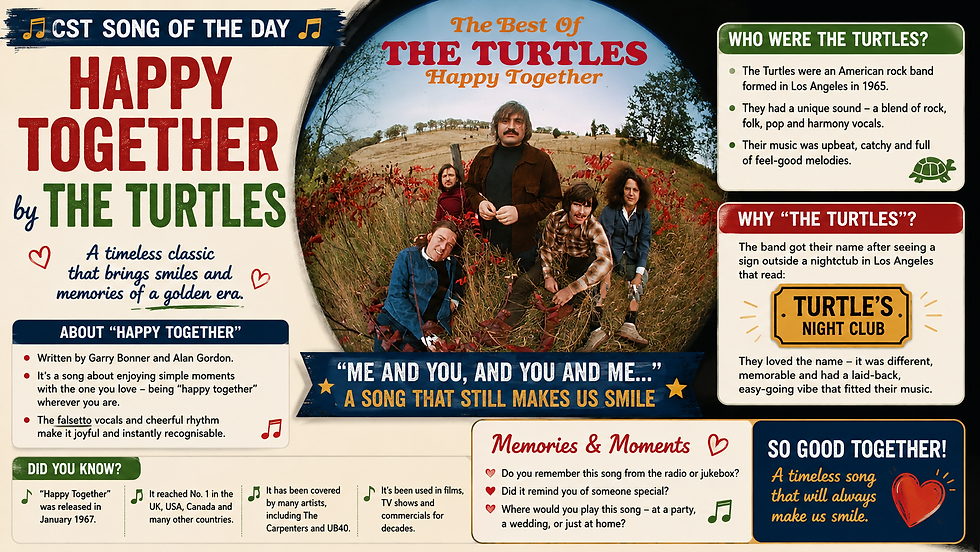
CST SONG OF THE DAY
“Happy Together” – The Turtles
Released in 1967, “Happy Together” became the band’s biggest hit and one of the defining feel-good songs of the 1960s. Its bright harmonies and optimistic lyrics made it instantly memorable.
The song works well in CST because it encourages singing along, discussion about relationships and reminiscence about the 1960s music scene.
Suggested linked activities:
Name famous animal groups or bands
Discuss favourite feel-good songs
Talk about friendship and togetherness
1960s memories and fashion

CST SONG OF THE DAY
“The 59th Street Bridge Song (Feelin’ Groovy)” – Simon & Garfunkel
Often remembered by the lyric:“Slow down, you move too fast…”
Released in 1966, this gentle and uplifting song encourages people to slow down and enjoy the simple pleasures of life. It links perfectly with the tortoise theme and discussions about taking life at a calmer pace.
Suggested linked activities:
Discuss how life has sped up over the years
Reminiscence about slower-paced childhoods
Mindfulness and enjoying simple pleasures
List things that help us relax and feel calm


Comments